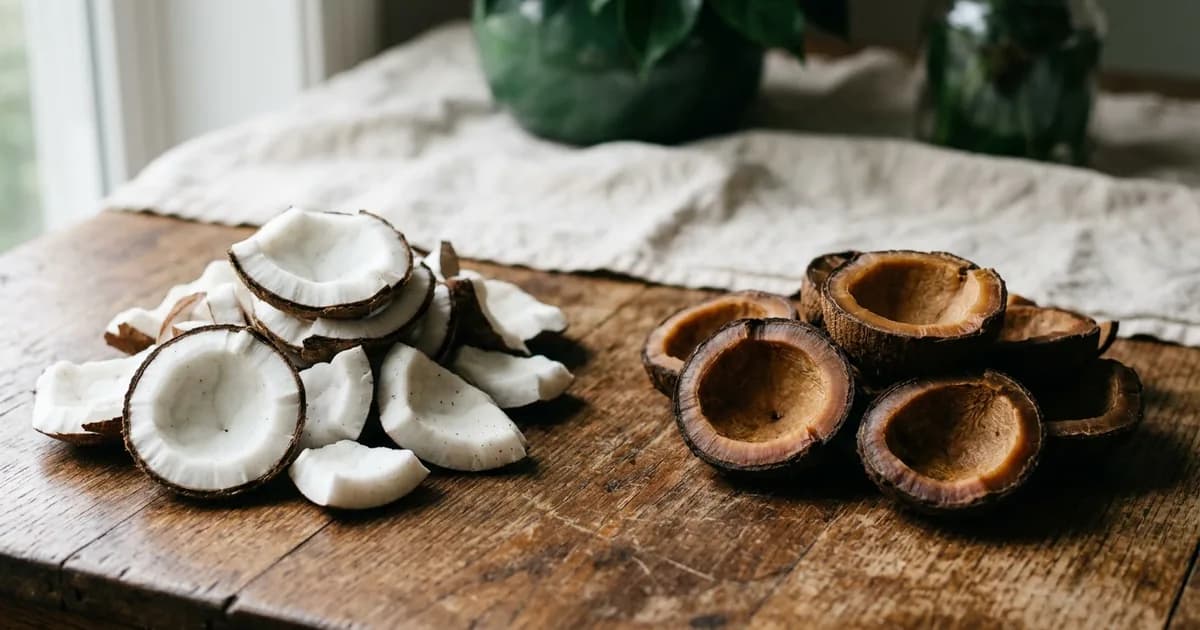
Smoked Copra vs Edible Copra: Key Differences for Buyers
Smoked copra and edible copra both feed coconut oil production, but drying method, colour, FFA, grade and use differ. Here is the comparison.
by ABRA BRIK Team
Smoked copra is industrial-grade copra dried with smoke, while edible copra is food-grade copra with much tighter quality limits. Smoked copra is brown to dark brown with a reference FFA of ≤ 3.0% and suits oil milling and refining. Edible copra has a reference FFA of ≤ 0.5% and is used for edible coconut oil and food processing.
This article compares the two by drying method, colour, FFA, grade and use. All figures come from the Kora Coconut catalogue. ABRA BRIK is a brand within Kora Coconut (PT Kora Prima Abadi), and both types of copra are supplied through the Kora Coconut catalogue.
What is copra?
Copra is dried coconut meat and the main raw material for coconut oil. Drying lowers the moisture so copra can be stored and shipped before it is pressed into oil. Drying method and quality control split copra into several types; the two buyers ask about most are smoked copra and edible copra.
Side-by-side specification
The table compares the reference specifications from the Kora Coconut catalogue. Final specifications are confirmed per shipment through pre-shipment inspection and the Certificate of Analysis (COA).
| Parameter | Smoked copra | Edible copra |
|---|---|---|
| Moisture | ≤ 7% | ≤ 5–6% |
| Oil content | 60–65% min | 60–65% min |
| FFA (free fatty acid) | ≤ 3.0% | ≤ 0.5% |
| Foreign matter | ≤ 1.0% | ≤ 0.5% |
| Mould | ≤ 5% | Nil / very minimal |
| Smoky | Not stated in the catalogue (smoke-dried) | ≤ 5% |
| Burnt | Not stated in the catalogue | ≤ 2% |
| Colour | Brown to dark brown | Clean and uniform (white copra) |
| Drying method | Smoke drying | Not stated in the catalogue |
| Grade | Industrial grade | Food grade |
How does the drying method differ?
According to the catalogue, smoked copra is smoke-dried: smoke from the fire reaches the coconut meat directly. This dries the copra but also leaves a darker colour and a smoky smell.
The catalogue does not state the drying method for edible copra. What it does state is that smoky pieces are limited to ≤ 5% and burnt pieces to ≤ 2%, so most of the copra must not be exposed to smoke or excess heat. If you need the drying method for a specific shipment, ask when you request the specification.
Why is the colour different?
Smoked copra is brown to dark brown because of contact with smoke and heat during drying. Edible copra, often called white copra, has a clean and uniform appearance. Colour is more than looks: it can carry over into crude oil, and oil from dark copra usually needs further processing, such as refining, before use.
How big is the FFA gap?
FFA (free fatty acid) is a marker of rancidity and the most important difference between the two:
- Smoked copra: FFA ≤ 3.0%.
- Edible copra: FFA ≤ 0.5%.
Moisture differs too: ≤ 7% for smoked copra and ≤ 5–6% for edible copra. Higher moisture opens the door to mould, and mould pushes FFA up. That is why smoked copra allows mould up to ≤ 5% while edible copra requires nil or very minimal mould. For more on what each figure means, read our article on edible copra moisture, oil content and FFA.
When should you choose each one?
Choose smoked copra if you run a coconut oil milling and refining plant, your crude oil will be processed further before sale, and you need a cost-effective raw material in large volumes.
Choose edible copra if you produce edible coconut oil, need a natural coconut aroma and clean appearance, and your process requires low FFA and high consistency.
For industrial buyers, we cover oil mill requirements in detail in smoked copra for coconut oil mills.
Is the oil content the same?
Yes. Both have a reference oil content of 60–65% minimum. The difference lies in the quality of the oil and how much further processing it needs, not in the amount of oil.
Frequently asked questions
What is the main difference between smoked and edible copra?
Smoked copra is smoke-dried, brown to dark brown and industrial grade with FFA ≤ 3.0%. Edible copra is food grade with FFA ≤ 0.5% and tight limits for mould, smoky and burnt pieces.
Can smoked copra be used for edible oil?
Smoked copra is intended for oil milling and refining, and its crude oil is usually processed further. For edible coconut oil directly, choose edible copra.
Which is more cost-effective?
The catalogue describes smoked copra as a cost-effective raw material for large-volume needs. Pricing for both is discussed according to volume and contract duration.
Does ABRA produce copra itself?
No. ABRA BRIK is a brand within Kora Coconut, and copra is supplied through the Kora Coconut catalogue.
Request a specification or sample
See the smoked copra and edible copra product pages. For a written specification, a sample or a volume-based quotation, contact us on WhatsApp or through the contact page.
Interested in our products?
Chat with us on WhatsApp for pricing, samples, and availability.
Chat via WhatsApp