Shisha vs BBQ Charcoal Briquettes: Shape, Ash and Burn Time
Both are coconut shell briquettes, but they are engineered for different jobs. Here is what actually separates them when you place an order.
by ABRA BRIK Team
Both are charcoal briquettes, both are usually made from coconut shell, and from a distance they look alike. But shisha and BBQ briquettes are engineered for different jobs — and a briquette that performs beautifully in one will disappoint in the other.
The difference is not branding. It is what happens after the coal is lit: one is drawn through water and inhaled, the other cooks food. That single fact dictates shape, ash content, and burn time.
The differences at a glance
| Aspect | Shisha briquette | BBQ briquette |
|---|---|---|
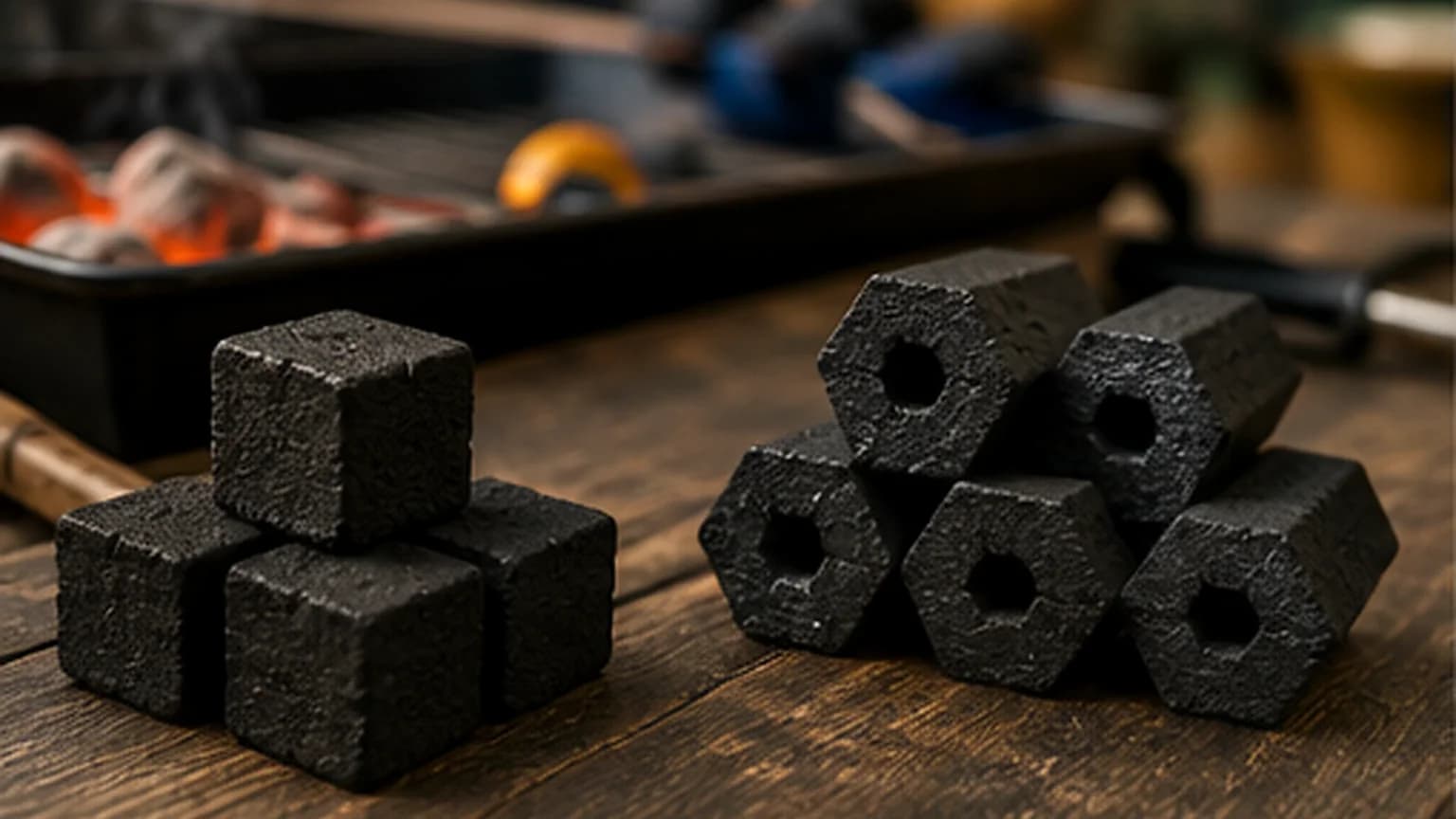
| Common shape | 25–26 mm cube, finger, stick | Hexagonal with a centre hole, pillow |
| Primary job | Steady, long heat without altering flavour | High, even heat for cooking |
| Ash content | Required as low as possible | More tolerance accepted |
| Odour & smoke | Must be neutral — the smoke is inhaled | Some smoke is acceptable |
| Typical packing | Small boxes, by the kilogram | Sacks or large cartons |
1. Shape follows the equipment
Shisha briquettes are small cubes because they must sit on foil or inside a heat management device. Uniform sizing makes the heat predictable: one cube for a short session, two or three for a long one. Finger and stick formats serve markets used to splitting coals by hand.
The hexagonal BBQ briquette does the opposite. The centre hole draws air through the core, so the coal lights faster and heat stays even along its length. Pillow shapes are cheaper to produce and dominate retail grilling.
2. Ash content — the decisive difference
This is why a cheap BBQ briquette cannot be substituted for shisha. Ash does not simply fall away; it builds on the bowl, blocks heat, and at higher levels becomes noticeable in the session. Shisha buyers — Middle Eastern importers above all — almost always ask about ash before anything else.
BBQ briquettes still need low ash to keep grills clean, but the accepted threshold is looser because the coal never touches what is inhaled.
3. Calorific value and burn time pull in opposite directions
Grilling wants high heat, reached quickly and held through the cook. Shisha wants stability: heat that does not spike, does not die early, and does not scorch the tobacco in the first minutes.
Our cube briquette was tested at the Ministry of Forestry laboratory (LHU 092/LHU/P2HB/07/2026): calorific value 7,319–7,500 kcal/kg, ash 2–3.56%, moisture 5.89%. These are the figures we send buyers — not marketing claims.
4. Raw material and binder
Both can be made from coconut shell charcoal, but shisha demands cleaner charcoal and tighter carbonisation control. Tapioca binder is kept to a minimum: excess binder leaves an odour when burned, and odour is a fatal defect in shisha.
BBQ briquettes allow a wider range of feedstock — wood charcoal, blends, other biomass — provided heat and cleanliness meet the grilling requirement.
5. Moisture decides what survives the voyage
An over-moist briquette is hard to light, crumbles easily, and risks mould inside a container. For export shipments measured in weeks, low and stable moisture matters more than an impressive calorific figure.
So which do you need?
- Shisha lounges, cafés, Middle East distributors → cube briquettes. Prioritise ash content and neutral odour.
- Restaurants, caterers, commercial grills → hexagonal briquettes. Prioritise burn time and even heat.
- Retail and home market → pillow shape, packaged with clear lighting instructions.
If you are still unsure, the fastest way to decide is not reading specifications — it is burning them. We send samples together with the laboratory report, so you can compare us against other suppliers using the same numbers.
See our premium shisha briquettes and hexagonal BBQ briquettes, or talk to our team about your requirement.
Interested in our products?
Chat with us on WhatsApp for pricing, samples, and availability.
Chat via WhatsApp