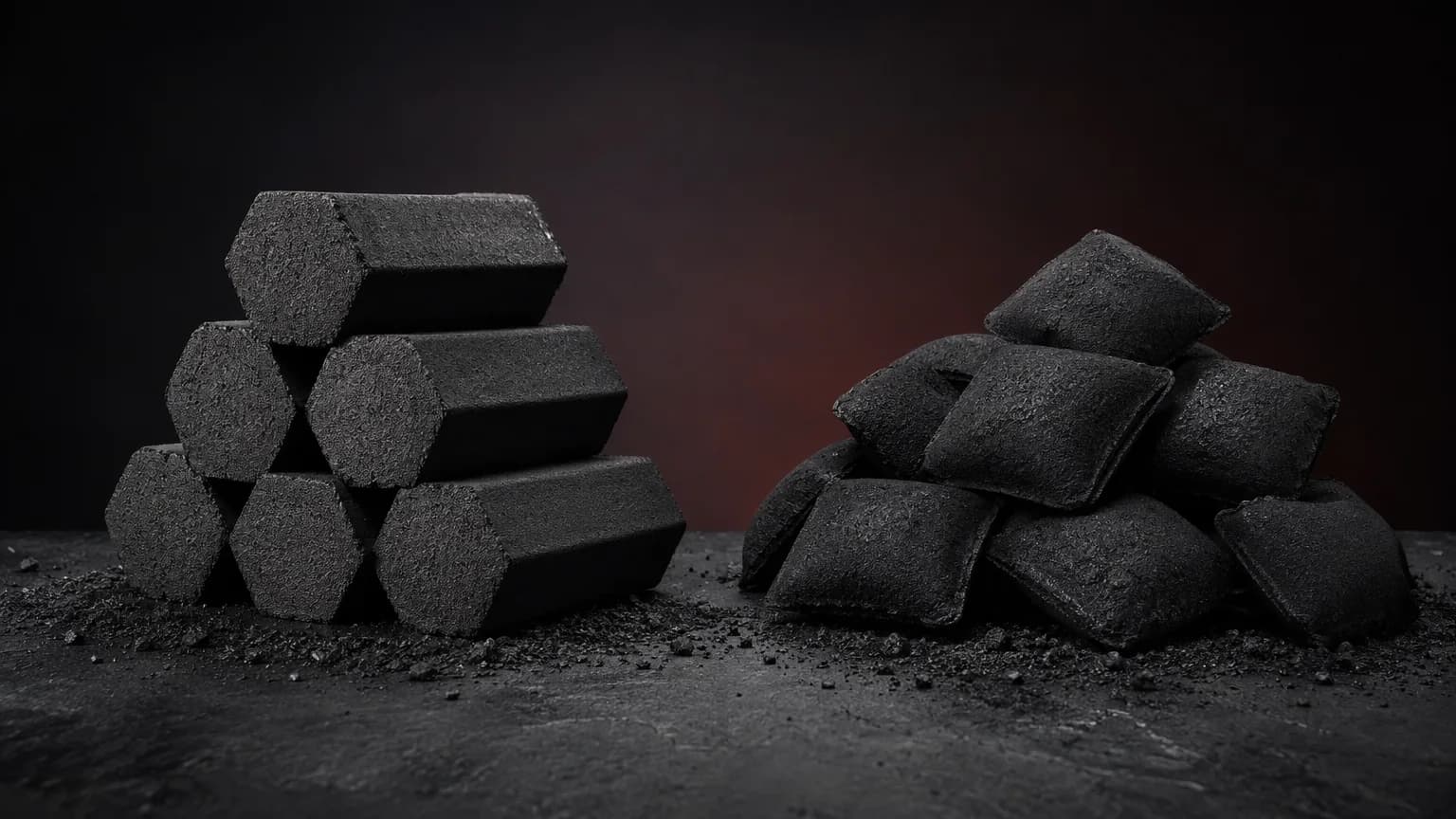
Briquette Shapes Compared: Hexagonal, Pillow, Cube and Finger
Shape is not decoration. It changes burn time, packing density and how many kilograms fit in a container — and each shape has a market that expects it.
by ABRA BRIK Team
Ask two buyers what a charcoal briquette looks like and you will get two different answers. A shisha lounge in Dubai pictures a 25mm cube. A barbecue distributor in Germany pictures a pillow. Both are right for their market, and ordering the wrong shape is one of the more expensive mistakes a first-time importer makes.
Hexagonal
A solid hexagonal bar, usually with a hole through the centre. That hole is the entire point: it pulls air through the middle of the briquette, so combustion happens from the inside out as well as the surface in.
The result is a long, steady burn at high heat, which is why hexagonal is the standard for commercial grilling — satay stalls, yakitori counters, restaurant grill lines. It holds temperature through a service instead of peaking early and fading.
Best for: restaurants, commercial kitchens, long grilling sessions.
Pillow
The rounded shape most Western consumers recognise from supermarket barbecue bags. Pillows light comparatively easily and bed down into an even layer, which suits an open kettle grill and a home user who wants coals ready in twenty minutes.
They burn faster than hexagonal at equivalent density — there is no central channel feeding the core — so they suit shorter sessions rather than an eight-hour smoke.
Best for: retail bags, home barbecue, consumer markets in Europe and North America.
Cube
The shisha and hookah standard. Cubes are produced to tight dimensions — 25 × 25 × 25mm is the reference size, with the broader market running roughly 20mm to 27mm — because they have to sit predictably on a bowl and heat tobacco evenly without tipping.
Cubes are also the most efficient shape to ship. Because they stack without voids, a 20-foot container takes up to around 18,000 kg of cube briquettes, against roughly 16,500 kg for finger, tube or hexagonal shapes. On a full container that difference is real money, and it is a point worth raising with your freight forwarder before you commit to a shape.
Best for: shisha, hookah, anywhere consistent dimensions matter.
Finger
Long and slender. Fingers light faster than cubes because of the surface-area-to-volume ratio, and some shisha markets prefer them for exactly that reason. They pack less efficiently than cubes, which is the trade-off.
Best for: shisha markets that specifically ask for it — and they will ask by name.
Choosing, in practice
Shape follows the customer, not the factory. Before specifying, answer three questions:
- Who burns it? A restaurant grill line and a home kettle want opposite things from the same kilogram of charcoal.
- How long does it need to hold? Long service periods point to hexagonal; short sessions to pillow.
- How is it shipping? If you are filling containers, cube density is worth real money per shipment.
We press hexagonal, pillow and cube, and we can produce to a dimension you specify rather than only to our standard sizes. What we will not do is guess — if you tell us the market and the burn behaviour your customer expects, we will tell you which shape actually fits it.
Unsure which shape your market expects? Tell us the destination country and the application, and we will walk through the options with you.
Interested in our products?
Chat with us on WhatsApp for pricing, samples, and availability.
Chat via WhatsApp