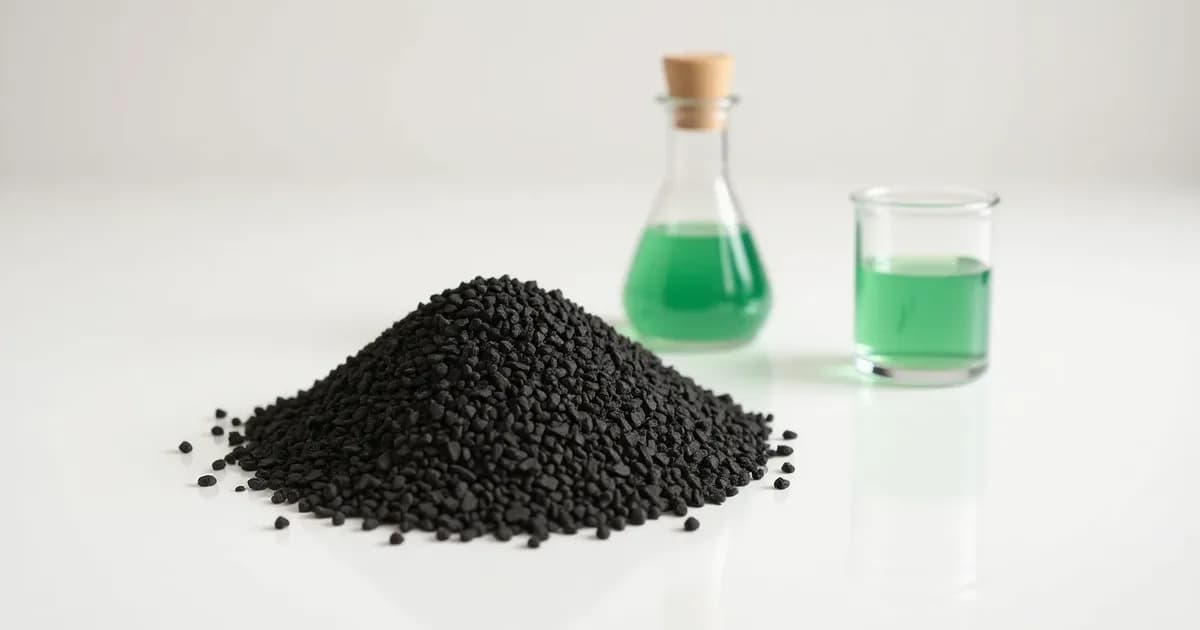
Granular Coconut Charcoal as Activated Carbon Feedstock
What granular coconut-shell charcoal is, why activated carbon makers use it, and how to choose among its five size ranges.
by ABRA BRIK Team
Granular coconut charcoal is charcoal made from 100% coconut shell, crushed and screened into uniform granules. Activated carbon producers use it as feedstock because the granules can go straight into activation without further crushing or screening. ABRA BRIK, a brand within Kora Coconut, supplies it in five standard size ranges from 2 to 20 mm.
This article explains what granular charcoal is, why coconut shell is a favoured activated carbon feedstock, how to choose a size range and what to tell your supplier. Every product figure here comes from the Kora Coconut catalogue and is a reference specification.
What is granular coconut charcoal?
Granular charcoal is charcoal in granule form: not lumps, and not powder. Coconut shell is carbonised, then crushed and screened until the granules fall within a set size range. The result is a uniform black granule.
- Lump charcoal is still in shell pieces; the buyer must crush and screen it.
- Granular charcoal is already screened to the range you choose.
- Charcoal powder is much finer and is measured in mesh, not millimetres.
Why is coconut shell used for activated carbon?
Activated carbon is charcoal that has been activated, usually with steam at high temperature or with chemicals. Activation opens up a large number of pores inside each granule, so the carbon can adsorb certain substances from water or air.
Coconut shell is a popular feedstock for well-known reasons:
- It is hard and dense, so granules tend to be strong and resist breaking during processing.
- It develops many fine pores after activation.
- It is renewable: the shell is a by-product of coconuts harvested for their meat and water.
- Its ash is low. Ash is the part that never becomes carbon, so less ash means more useful material.
What is the ABRA BRIK granular specification?
| Parameter | Reference value |
|---|---|
| Ash content | ≤ 3% |
| Appearance | Black granular charcoal |
| Fixed carbon | ≥ 80% |
| Volatile matter | ≤ 15% |
| Moisture | ≤ 8% |
| Sulfur | ≤ 0.05% |
| Bulk density | 400–550 kg/m³ |
| Raw material | 100% coconut shell |
Specifications may vary with origin, season, production method and customer requirements. Final figures are confirmed through pre-shipment inspection and a Certificate of Analysis (COA). Each line of this table is explained in our article on granular charcoal specifications.
Which size range should you choose?
Five standard ranges are available: 2–5 mm, 3–6 mm, 4–8 mm, 5–10 mm and 10–20 mm. Custom sizes can be made on request. No single size is right for everyone. Your choice depends on three things:
- Your final product size. If you sell granular activated carbon in a set size, choose feedstock close to that size to reduce re-screening.
- Your activation kiln or reactor. Every unit has a granule size it handles well. Follow the equipment maker's limits or your line's own experience.
- Gas and heat flow inside the unit. Larger granules leave wider gaps; smaller granules pack more tightly.
The safest way to decide is to request samples of the two ranges closest to your needs and test them on your own line.
What should you tell your supplier?
- The size range you need, and how much undersize or oversize you accept.
- Target specifications such as limits for ash, fixed carbon and moisture.
- Your test methods, so both labs compare like with like.
- Volume and schedule per shipment and how often.
- Packaging you prefer.
- Destination and the export documents you need, such as a COA, Certificate of Origin, Packing List or third-party inspection.
We do not publish a price list. Pricing is discussed according to volume and contract duration, so every quotation is prepared per request.
Frequently asked questions
What is the difference between granular charcoal and activated carbon?
Granular charcoal is the feedstock. Activated carbon is the end product, made after activation opens up the charcoal's pores.
Which sizes are available?
Five standard ranges: 2–5, 3–6, 4–8, 5–10 and 10–20 mm. Custom sizes are available on request.
Can granular charcoal be used for briquettes?
Yes. The Kora Coconut catalogue lists it for activated carbon production, briquette manufacturing and other industrial processing. Many briquette makers prefer coconut charcoal powder.
Can I get a sample?
Yes. Send your application, size range, target volume and destination on WhatsApp.
Next step
See the full table on the Granular Coconut Charcoal page. For samples, a written specification or a quotation, message us on WhatsApp or use our contact page.
Interested in our products?
Chat with us on WhatsApp for pricing, samples, and availability.
Chat via WhatsApp