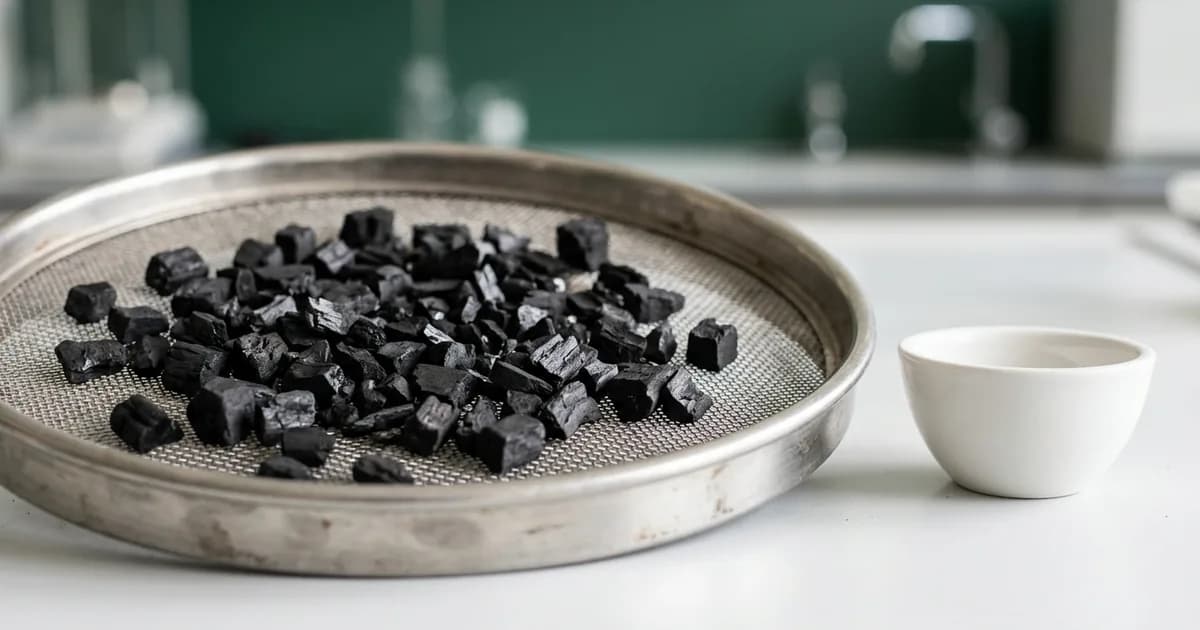
Granular Charcoal Specifications Explained, Line by Line
A plain-language guide to every line of a granular coconut charcoal spec sheet: ash, fixed carbon, volatile matter, moisture, sulfur and bulk density.
by ABRA BRIK Team
A granular charcoal specification tells you how much usable carbon is in each granule, and how much is dead weight such as ash, water and volatile matter. For ABRA BRIK granular coconut-shell charcoal, the reference figures are fixed carbon ≥ 80%, ash ≤ 3%, volatile matter ≤ 15%, moisture ≤ 8%, sulfur ≤ 0.05% and bulk density 400–550 kg/m³. Final figures are confirmed per shipment through pre-shipment inspection and a COA.
This article explains each line in plain language, so you can read a spec sheet or COA with confidence and compare it with what your production line needs.
What does the full specification look like?
| Parameter | Reference value | In short |
|---|---|---|
| Ash content | ≤ 3% | Mineral residue after full burning |
| Appearance | Black granular charcoal | Physical form |
| Fixed carbon | ≥ 80% | The solid, usable carbon |
| Volatile matter | ≤ 15% | What escapes as gas when heated |
| Moisture | ≤ 8% | Water inside the granules |
| Sulfur | ≤ 0.05% | Sulfur content |
| Foreign matter | n/a | Not stated in the catalogue |
| Bulk density | 400–550 kg/m³ | Weight per volume of a loose pile |
| Raw material | 100% coconut shell | Source material |
Granules come in five size ranges: 2–5, 3–6, 4–8, 5–10 and 10–20 mm.
What does ash content mean?
Ash content is the percentage of mineral residue left after the charcoal is fully burned in a lab. Ash never becomes carbon, so for most processes it is wasted material. Lower ash means cleaner charcoal and, for activated carbon makers, fewer impurities carried into the final product. Our reference limit is ≤ 3%.
What does fixed carbon mean?
Fixed carbon is the solid carbon that remains after water and volatile matter are driven off. It is usually calculated as what is left once moisture, ash and volatile matter are subtracted. Higher fixed carbon means more material you can turn into activated carbon or other carbon products. Our reference limit is ≥ 80%.
What does volatile matter mean?
Volatile matter is the part that escapes as gas when charcoal is heated without air in a lab. It shows how complete the carbonisation was. Low volatile matter means the shell was properly turned into charcoal; high volatile matter means some material was not, and it will escape when you heat the charcoal again. Our reference limit is ≤ 15%.
Why does moisture matter?
Moisture is the water inside the granules. Water adds weight but no value, and it takes energy to evaporate before your process can start. Charcoal picks up humidity during storage and transit, so moisture in your warehouse can differ from the figure at packing. Store charcoal in a dry, covered area. Our reference limit is ≤ 8%.
Why is sulfur listed?
Sulfur is unwanted in many processes. When burned it can form polluting, smelly gases, and in carbon products it can act as an impurity. Our reference limit is ≤ 0.05%. This low limit matters if your process is sensitive to sulfur; always check it against your buyer's or your internal limits.
What is bulk density, and why should you care?
Bulk density is the weight of granules per cubic metre of a loose pile, including the air gaps between granules. It differs from the density of a single granule. It helps you:
- Plan loads: estimate how much weight fits in a bag, big bag or container.
- Fill equipment: know how much material fills a kiln or reactor of a given volume.
- Compare lots: a large shift in bulk density can signal a change in granule size or material quality.
Our reference range is 400–550 kg/m³. Granule size affects it, because the gaps between granules differ for each size range.
How do you use these figures when buying?
- Decide which figures matter most to your process; for activated carbon, usually ash and fixed carbon.
- Agree on test methods and write them into the contract, because different methods give different results.
- Request a sample and test it yourself before a large-volume contract.
- Compare each shipment's COA with your own warehouse tests.
Frequently asked questions
Are catalogue figures guaranteed for every shipment?
No. They are reference specifications that may vary with origin, season, production method and customer requirements. Final figures are confirmed through pre-shipment inspection and a COA.
Why is foreign matter shown as n/a?
The Kora Coconut catalogue gives no foreign-matter figure for granular charcoal. If you need a limit, include it in your request for a quotation.
Can the specification be customised?
Custom granule sizes are available on request. For other targets, share your needs and our team will discuss what is possible.
Next step
See the product on the Granular Coconut Charcoal page, or read our guide to granular coconut charcoal for activated carbon. Pricing is discussed according to volume and contract duration. Request a written specification or a sample on WhatsApp or via our contact page.
Interested in our products?
Chat with us on WhatsApp for pricing, samples, and availability.
Chat via WhatsApp