Edible Copra Quality Checklist for Buyers Before Contract
A practical checklist before you sign an edible copra contract: samples, spec sheet, smoky and mould limits, inspection and documents.
by ABRA BRIK Team
Before you sign an edible copra contract, check five things: a physical sample, a written specification sheet, limits for smoky, burnt and mouldy pieces, a pre-shipment inspection plan, and the quality and export documents. This checklist helps you make sure the copra that arrives matches the copra you were promised. All figures in this article are reference specifications from the Kora Coconut catalogue.
ABRA BRIK is a brand within Kora Coconut (PT Kora Prima Abadi). Edible copra is supplied through the Kora Coconut catalogue, and its final specification is confirmed per shipment through pre-shipment inspection and the Certificate of Analysis (COA).
Why use a checklist before signing?
Copra is a natural product. Its quality can vary with origin, season and processing. A contract that only says "edible copra" without figures leaves room for misunderstanding. A checklist puts your expectations in writing in a form that can be measured, so you have a clear basis to judge each shipment. If you are not yet sure what each figure means, start with our article on edible copra moisture, oil content and FFA.
1. Have you tested a sample?
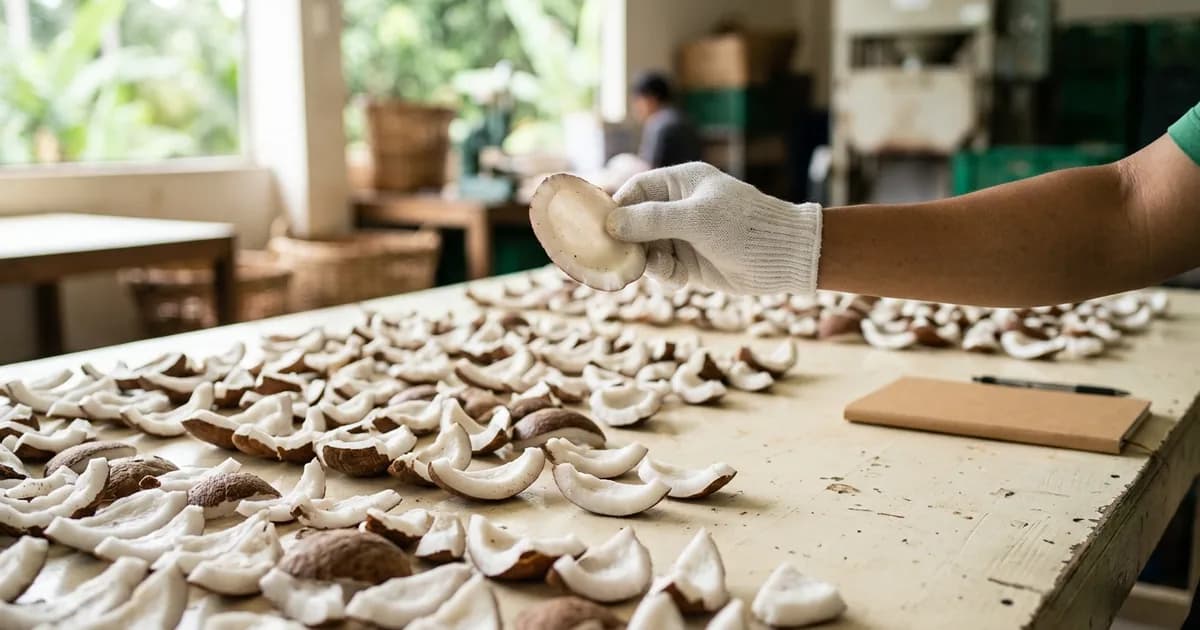
A sample lets you see the colour, smell the aroma and test the copra in your own laboratory. When it arrives, check:
- Colour and appearance. Edible copra should look clean and uniform.
- Aroma. The catalogue reference is a natural coconut aroma. A strong smoky, musty or rancid smell is a warning sign.
- Defective pieces. Separate smoky, burnt or mouldy pieces and compare them with the specification limits.
- Lab results. Test moisture, oil content and FFA using the methods your mill normally uses.
Keep part of the sample as a reference for judging the first shipment.
2. Is the specification in writing?
Ask for a written specification sheet and attach it to the contract. The reference specification for edible copra from the Kora Coconut catalogue:
| Parameter | Reference specification |
|---|---|
| Moisture | ≤ 5–6% |
| Oil content | 60–65% min |
| FFA (free fatty acid) | ≤ 0.5% |
| Foreign matter | ≤ 0.5% |
| Smoky | ≤ 5% |
| Burnt | ≤ 2% |
| Mould | Nil / very minimal |
| Grade | Food grade |
| Aroma | Natural coconut aroma |
Make sure every figure in the contract has a unit and a clear limit, such as "maximum" or "minimum". Agree on the test methods and the reference laboratory in case results differ.
3. What are the limits for smoky, burnt and mouldy pieces?
These limits are often overlooked, yet they shape the quality of edible oil:
- Smoky: ≤ 5%. Smoke-exposed pieces can carry a smoky smell into the oil.
- Burnt: ≤ 2%. Burnt pieces affect oil colour and taste.
- Mould: nil or very minimal. Mould shows the copra was once damp and can push FFA up.
- Foreign matter: ≤ 0.5%. Stones, fibre or dirt add weight without adding oil.
Write down how these limits are measured: how many samples are drawn from each lot and how defective pieces are separated and weighed.
4. Who inspects before shipment?
Pre-shipment inspection is a quality check before goods are loaded. Agree on who inspects (the supplier, your team or a third party), which parameters and methods are used, when and where samples are drawn, and what happens if a result falls outside the limits: rejection, replacement or renegotiation. Because moisture and FFA can change in transit, also discuss packaging and storage conditions during shipping.
5. Which documents do you need?
According to the Kora Coconut catalogue, the documents that can be prepared, depending on product and destination, include:
- Certificate of Analysis (COA)
- Commercial Invoice and Packing List
- Bill of Lading
- Certificate of Origin
- Phytosanitary Certificate
- Fumigation Certificate
- Third-Party Inspection
Check the import rules in your country and list the required documents in the contract.
What about price and volume?
We do not publish prices for edible copra. Pricing is discussed according to volume and contract duration. Prepare your expected volume, delivery schedule and destination before asking for a quotation.
Frequently asked questions
Can I get an edible copra sample before signing?
Yes. Samples are available on request. Send your application, expected volume and destination on WhatsApp or through our contact page.
What is pre-shipment inspection?
It is a quality check before goods are shipped to confirm the copra meets the contract specification. A third party can inspect if you request it.
Are the catalogue figures final?
No. They are reference specifications. The final specification is confirmed per shipment through pre-shipment inspection and the COA.
What is the mould limit for edible copra?
The Kora Coconut catalogue reference for mould is nil or very minimal. Smoky pieces are limited to ≤ 5% and burnt pieces to ≤ 2%.
Ready to request a specification or sample?
See the product details on the edible copra page. For a specification sheet, a sample or a quotation based on volume and contract duration, contact us on WhatsApp or through the contact page.
Interested in our products?
Chat with us on WhatsApp for pricing, samples, and availability.
Chat via WhatsApp