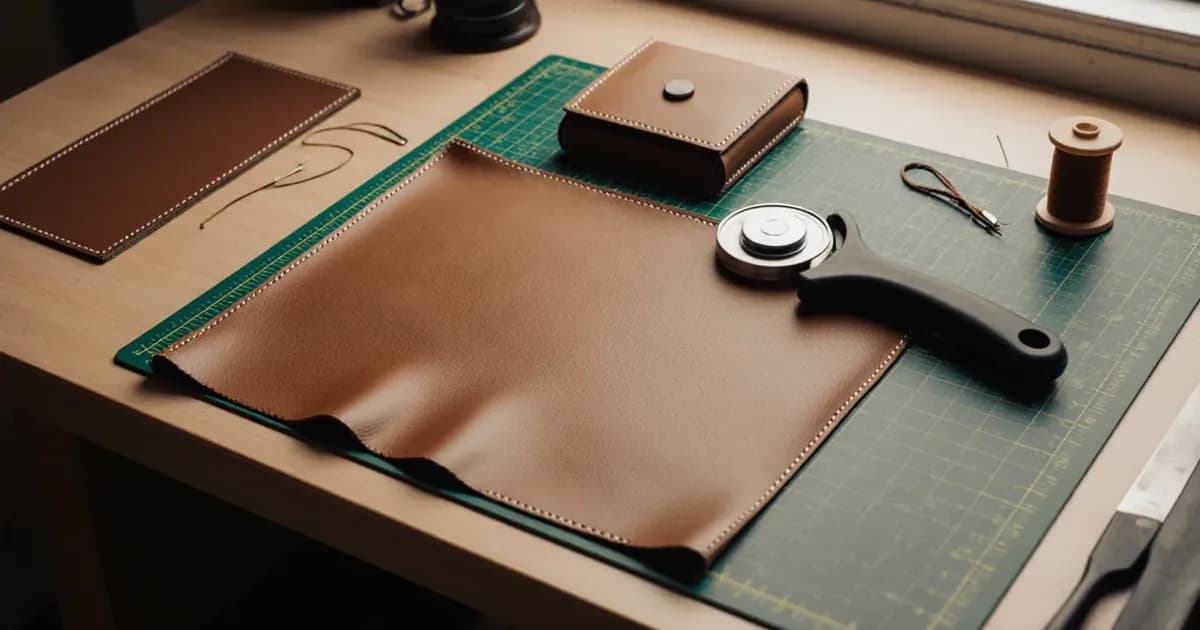
Choosing Coconut Bioleather for Fashion Products and Bags
How to choose a 0.5–2.0 mm thickness and finish of coconut bioleather for bags, covers and accessories, how to test cutting and stitching, and what to send for a sample.
by ABRA BRIK Team
To choose coconut bioleather, start from the product you want to make, then pick a thickness within the 0.5–2.0 mm range and a matte to semi-matte surface finish. The thin end of the range is more flexible and folds easily, while the thick end is firmer and holds its shape. Always test cutting and stitching on a sample before production, because thickness, size and finish are set per project.
This guide is for fashion brands, bag and accessory makers, and stationery studios. Material data comes from the Kora Coconut catalogue. ABRA BRIK is a brand within Kora Coconut (PT Kora Prima Abadi), and coconut bioleather is supplied through the Kora Coconut catalogue.
What should you know about the material first?
Coconut bioleather is a plant-based sheet material. According to the catalogue it is 0.5–2.0 mm thick, matte to semi-matte, flexible and foldable, has a natural organic grain, and can be cut and stitched. If you are new to it, start with what is coconut bioleather.
How do you choose the right thickness?
Thickness is the first and most important decision. It affects flexibility, stiffness, weight and how the material sews. The general pointers below are a starting point; the final choice must be tested on a sample.
Thin end of the range
Thinner sheets are more flexible and fold easily. They suit parts that need to follow a shape, such as linings, small pouches, wraps or book covers that are opened and closed often.
Middle of the range
A medium thickness balances flexibility and firmness. It is often a good starting point for accessories such as small wallets, card holders or journal covers.
Thick end of the range
Thicker sheets are stiffer and hold their shape better. They are worth trying for bag bodies, bag panels or products that need to stand upright.
Load-bearing parts such as straps or handles need special care. The catalogue does not list tensile strength, so test these parts under a real load before you decide.
Which finish suits your product?
The catalogue lists a matte to semi-matte surface. Matte gives a calm, natural look where the grain is more noticeable; semi-matte adds a slight sheen for a neater appearance. Look at and handle both options on a sample under the same light as where your product will be displayed, since photos on screen rarely show texture accurately.
How should you test cutting and stitching?
The catalogue states the material can be cut and stitched, but every workshop has its own tools and methods. Test on a sample with the tools you will actually use in production.
Cutting test
- Cut straight lines and curves with your usual knife or cutting tool.
- Check the cut edges: clean, fibrous or prone to tearing.
- If you use a die-cutting machine or laser, test a small piece before cutting a full pattern.
Stitching test
- Try several needle sizes and stitch lengths.
- Sew single and multiple layers, matching your product's construction.
- Pull the seam by hand, then fold and unfold it repeatedly. Watch whether needle holes widen or the material tears along the seam.
Other tests to consider
If your product uses glue, printing or embossing, test those too. Simple rub and fold tests also help for products in daily use.
Why test samples first?
The Kora Coconut catalogue itself recommends samples for evaluation before commercial orders, because specifications, dimensions and finishes may vary with project requirements, raw material availability and manufacturing method. Testing a sample lets you confirm thickness and finish against your design, catch cutting or stitching problems before large runs, and write a clear specification for the next order.
What should you send when requesting a sample?
- Product type: bag, book cover, wallet or garment detail.
- Part size: the approximate size of the largest panel or pattern piece.
- Preferred thickness: one or more options within 0.5–2.0 mm.
- Finish: matte, semi-matte, or both to compare.
- Production process: how you cut, sew and join the material.
- Expected volume and timeline, so we can prepare a quotation.
- Destination country, if the goods will be shipped abroad.
We do not publish prices for coconut bioleather. Pricing is discussed according to volume, project specification and contract duration.
Frequently asked questions
What thickness suits a bag?
For a bag body that must hold its shape, start testing from the thick end of the 0.5–2.0 mm range. For linings and pouches, the thin end is usually easier to shape. Confirm with a sample test.
Can coconut bioleather be machine-stitched?
The catalogue states it can be cut and stitched. Test seams on a sample with the machine, needle and stitch length you will use in production.
Can size and finish be customised?
Yes. According to the catalogue, thickness, size and finish follow project requirements.
Is a sample required before a large order?
The Kora Coconut catalogue recommends samples for evaluation before commercial orders. It is the safest way to confirm the material suits your product.
Start with a sample
See the product details on the coconut bioleather page. Send your product details on WhatsApp or through the contact page, and we will help prepare a suitable sample.
Interested in our products?
Chat with us on WhatsApp for pricing, samples, and availability.
Chat via WhatsApp