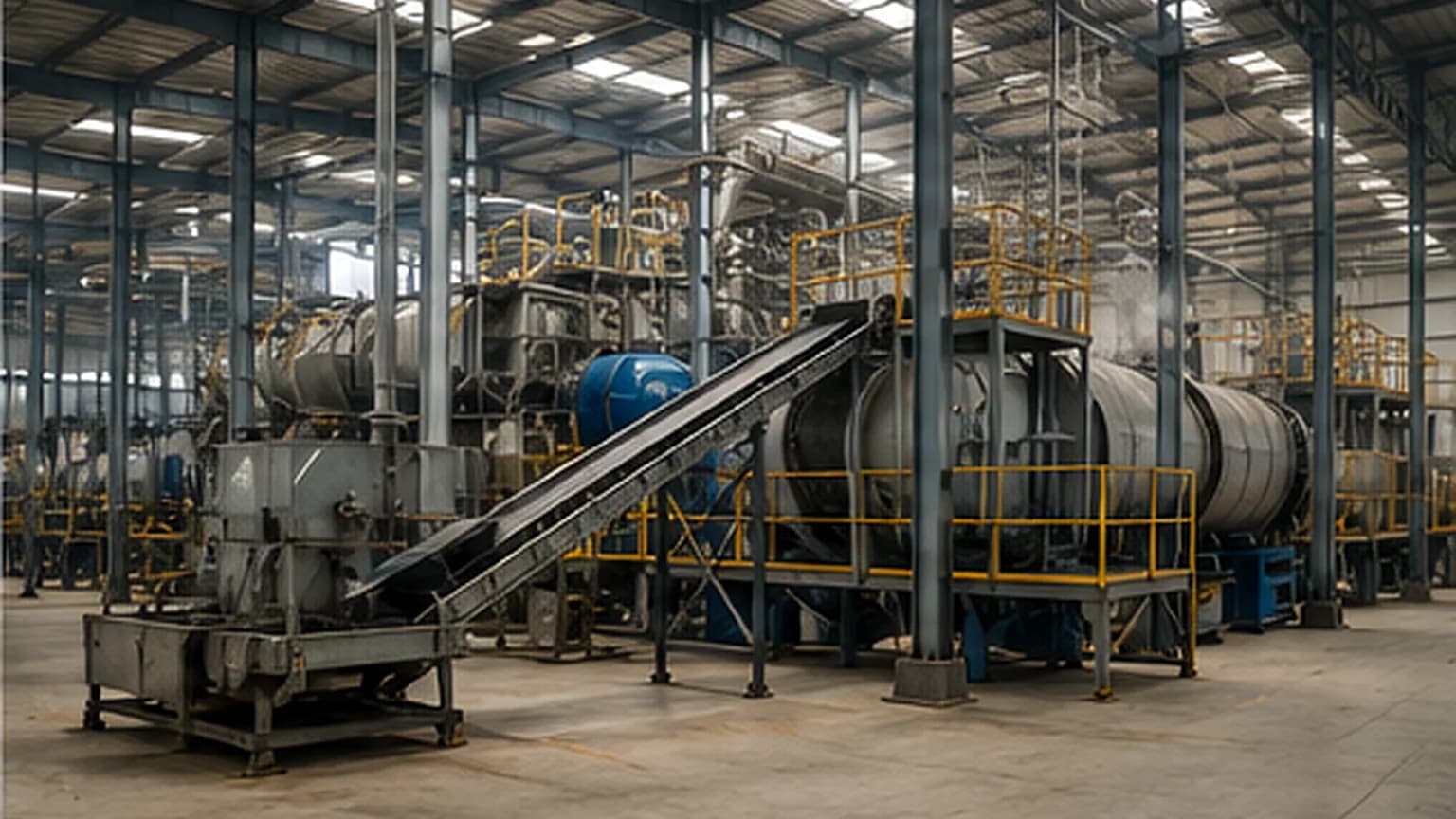
A Charcoal Factory in Bogor: From Coconut Shell to Export-Ready Briquette
Carbonisation is easy to describe and hard to control. Here is what actually happens, stage by stage, on our line in Ciomas, Bogor.
by ABRA BRIK Team
Bogor is not a coconut-growing region. But Bogor is close to Jakarta, to the ports, and to the Greater Jakarta distribution network — and that is what decides where a charcoal factory serving city buyers and export markets should sit.
Our factory is in Ciomas, Bogor Regency. Here is what happens between the coconut shell arriving and the briquette going into a container.
1. Raw material arrives and is sorted
Coconut shell comes from coconut-producing regions, not from Bogor itself. The first checks are cleanliness and dryness: shell with husk still attached, or shell that is too wet, will disrupt carbonisation at the next stage.
The feedstock is 100% coconut shell — for lump, granular and powder charcoal, biochar and briquettes — each with its own parameters.
2. Carbonisation — the stage that decides everything
Shell is burned under restricted oxygen so water and volatiles leave, and carbon remains. It sounds simple; in practice this is the hardest stage to control.
Too low a temperature leaves uncarbonised material — the result smokes and smells when burned. Too high burns away the carbon that should have become product, so yield falls and ash rises. Buying the same kiln as an established producer does not give the same output; the parameters are the hard part, not the equipment.
3. Milling and screening
Charcoal is milled to a fine powder and screened. Particle uniformity decides briquette density and how evenly it burns. Particles that are too coarse leave the briquette fragile at the corners — and crumbling corners are the most common complaint from export buyers.
4. Binder mixing
Charcoal powder is mixed with tapioca binder and water, deliberately at the lowest workable dose. Excess binder makes a strong briquette that smells when burned — a fatal defect for shisha, and still a nuisance for BBQ.
5. Pressing to the intended use
Cubes for shisha, hexagonal with a centre hole for commercial grilling, pillow for retail. Shape is not preference; it follows the equipment that will burn it — we cover this in shisha vs BBQ briquettes.
6. Drying
Wet briquettes are dried until moisture falls to a level safe for long storage and sea freight. New producers underestimate this stage more than any other: a briquette that looks perfect at the factory can grow mould in a container after three weeks at sea.
7. Testing and packing
Samples go to the laboratory. Our cube briquette is recorded under LHU 092/LHU/P2HB/07/2026: calorific value 7,319–7,500 kcal/kg, ash 2–3.56%, moisture 5.89%.
Those figures travel with our quotation — not a self-typed specification table. If you are comparing suppliers, ask all of them for an equivalent document.
Why location matters to a buyer
For Greater Jakarta buyers, proximity means lower freight and a delivery schedule that can actually be promised. For export buyers, being near the ports means fewer handling steps — and every extra handling step is another chance for briquettes to break.
See our product catalogue, or read how to tell grade A from grade C coconut charcoal.
Our capacity is 50+ tonnes of briquettes a month, plus charcoal and biochar up to 90 tonnes a month, from three production sites in Bogor. Talk to our team and request samples with the test report.
Interested in our products?
Chat with us on WhatsApp for pricing, samples, and availability.
Chat via WhatsApp