Charcoal Briquette Supplier Indonesia: How to Vet One Before You Order
Most buyer disappointment is not fraud. It is ordering from a broker who believed they were a factory. Here is how to tell the difference.
by ABRA BRIK Team
Indonesia is the world's largest exporter of coconut shell charcoal — 163,321 tonnes in 2022 according to the International Coconut Community. The consequence: hundreds of parties present themselves as suppliers, and most are not factories.
That does not make them dishonest. Many brokers are useful and straightforward. The problem appears when you believe you are talking to a factory and you are not: specification promises are being made by someone who does not control production.
1. Ask for the laboratory report, not the spec table
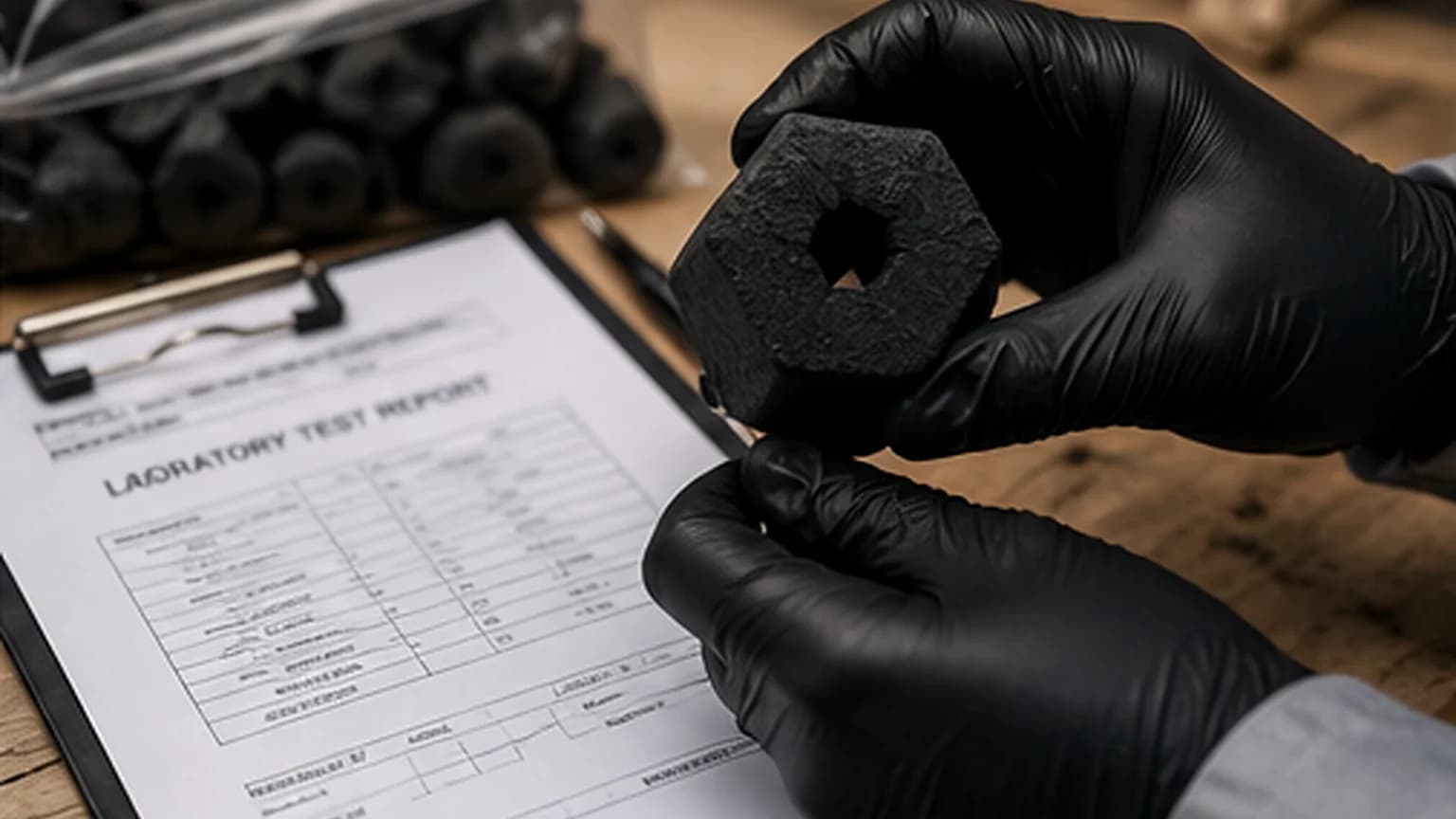
A spec table can be typed by anyone. A laboratory report carries a number, a date, and an institution you can verify.
Our cube briquette was tested at the Ministry of Forestry laboratory under LHU 092/LHU/P2HB/07/2026: calorific value 7,319–7,500 kcal/kg, ash 2–3.56%, moisture 5.89%. If a prospective supplier cannot produce an equivalent document, you are evaluating a claim rather than a product.
2. Ask about batch consistency, not best-case numbers
The question that separates experienced buyers: "What was the ash spread between your best and worst batch this year?"
A supplier who controls production can answer. One who buys from collectors will change the subject. A single batch figure means nothing if your second container differs from your first.
3. Check capacity against your order
A supplier with 10 tonnes a month who accepts a 40-tonne order will fill the gap from elsewhere — and that is exactly where consistency disappears. Ask for monthly capacity, then weigh it against your requirement plus their other customers.
4. Samples must arrive with context
A sample sent without documentation cannot be assessed. What is useful: a sample drawn from a real production batch, with its production date and test result, so you can compare it against the next shipment.
Be wary of a sample noticeably better than its own written specification. That usually means it was hand-picked rather than drawn at random.
5. Confirm the shape matches the use
Cubes for shisha, hexagonal with a centre hole for commercial grilling, pillow for retail. A supplier offering one shape for every purpose is generally selling what they have rather than what you need. We cover this separately in shisha vs BBQ briquettes.
6. Settle packaging before quantity
Correct briquettes can still arrive ruined through wrong packing. For a voyage measured in weeks, what matters is moisture protection and stack strength inside the container — not how the box looks.
7. Notice who answers the technical questions
If every question about ash content, carbonisation temperature, or binder has to be "checked with the factory", you are not speaking to the factory.
Quick checklist
- Numbered laboratory report, not a spec table
- A straight answer on batch-to-batch spread
- Monthly capacity that makes sense for your order
- Samples from a real, dated batch
- Shape matched to the application
- A packing plan built for sea freight
- Technical questions answered directly
We supply buyers in seven countries from three production sites in Bogor, with briquette capacity of 50+ tonnes per month and charcoal and biochar up to 90 tonnes per month. Talk to our team to discuss your requirement and request samples with the accompanying test report.
Interested in our products?
Chat with us on WhatsApp for pricing, samples, and availability.
Chat via WhatsApp