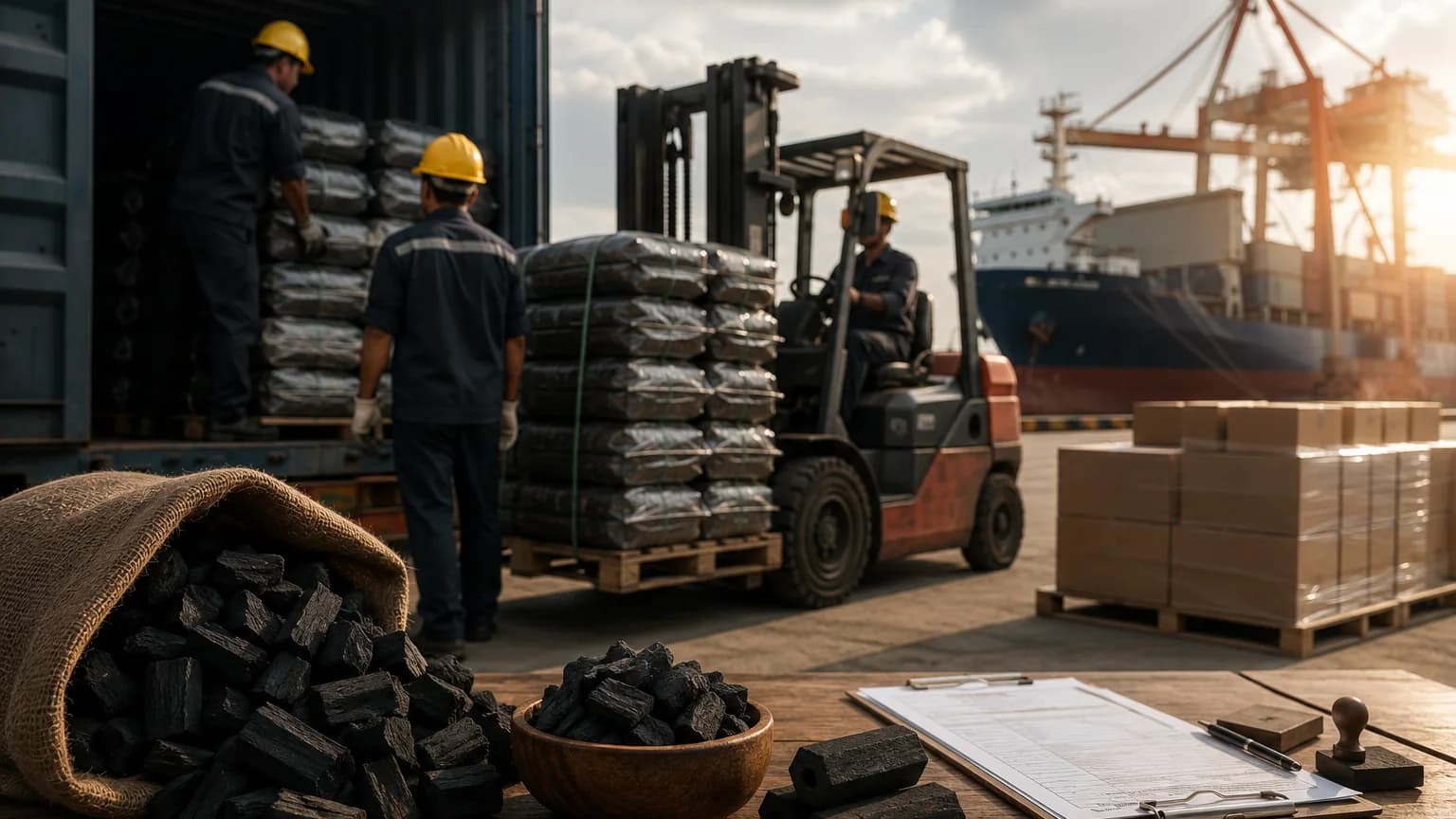
Importing Coconut Charcoal from Indonesia: A Buyer's Walkthrough
The sequence that separates a smooth first container from an expensive lesson — specification, sample, agreement, inspection — and what goes wrong when a step is skipped.
by ABRA BRIK Team
Most problems with a first charcoal container are not manufacturing problems. They are sequence problems — a step skipped early that only becomes visible when the shipment lands and the material is not what the buyer pictured.
Here is the order that sequence should run in, and what tends to go wrong at each stage.
1. Fix the specification before asking for a price
A quotation without a specification is meaningless, because the supplier is free to quote whatever material makes the number work. Before requesting a price, decide:
- Application — shisha, BBQ, or industrial. These are genuinely different products, not grades of the same one.
- Shape and dimension — cube, hexagonal, pillow or finger, with the size in millimetres.
- Ash ceiling and calorific floor — the two figures your customer will actually check.
- Moisture ceiling — critical for sea freight, and the one buyers forget.
- Packaging — inner box, pouch, carton, and whose branding goes on it.
If you do not know some of these yet, say so rather than guessing. A supplier who knows the destination market can usually tell you what that market expects.
2. Sample before you commit
Ask for a pre-production sample and burn it yourself, on the equipment your customer uses. Documents describe material; they do not tell you how it behaves in a bowl or on a grate.
What to check: time to ready, how long usable heat holds, how much ash and when it appears, whether there is any smell when lighting. Charcoal that ashes over early will drop your customer's working temperature mid-service — a failure no specification sheet predicts.
Approve the sample in writing. That approved sample becomes the reference for everything that follows.
3. Get the specification into the agreement
This is the step most often skipped, and the most expensive one to skip.
If the ash figure matters, it belongs in the cooperation agreement with a number next to it — not in a chat thread. So do volume, delivery schedule, packaging, and what happens if a batch falls outside specification. A verbal understanding is worth nothing when a container is already on the water.
4. Verify with a laboratory report
Ask for a test report on the material being supplied, naming the testing institution and the standard used. A generic company brochure is not a test report.
Our own briquettes are tested at the Ministry of Forestry laboratory in Bogor — accredited by KAN, Indonesia's national accreditation committee — against SNI 06-3730-1995. Report 092/LHU/P2HB/07/2026 records 7,319 cal/g, 3.56% ash and 5.89% moisture for the cube format.
We publish those figures rather than adjectives, including where they place the product. That ash figure is BBQ-grade, not the sub-2.5% premium shisha bracket, and we would rather a buyer know that before ordering than after.
5. Understand what the documents do
Export paperwork varies by destination country, and the only reliable source is your own customs broker at the destination — not a supplier's blog post, including this one. What is consistent is the general shape:
- Commercial invoice and packing list — the commercial basis of the shipment.
- Bill of lading — issued by the carrier, your title to the goods.
- Certificate of Origin — often needed for preferential duty rates.
- Certificate of Analysis — the laboratory figures for the batch shipped.
- MSDS — safety data, requested by many carriers and ports.
Some destinations add fumigation certificates or specific product registrations. Confirm your list with your broker before production starts, because several of these must be arranged during production, not after.
6. Inspect before the container closes
Packaging, counts and moisture should be checked before sealing. Once a container is closed and on the water, every problem becomes dramatically more expensive to fix.
What it looks like from our side
We produce over 50 tonnes of briquettes a month, and up to 90 tonnes a month across charcoal and biochar, from three locations. We currently ship to buyers in seven countries. Neutral or own-brand packaging is available — our branding is not a condition of supply.
What we will not do is quote a specification we have not tested, or promise a grade our laboratory report does not support.
Working on a first order and unsure what to specify? Tell us the destination market and the application, and we will walk through it with you.
Interested in our products?
Chat with us on WhatsApp for pricing, samples, and availability.
Chat via WhatsApp