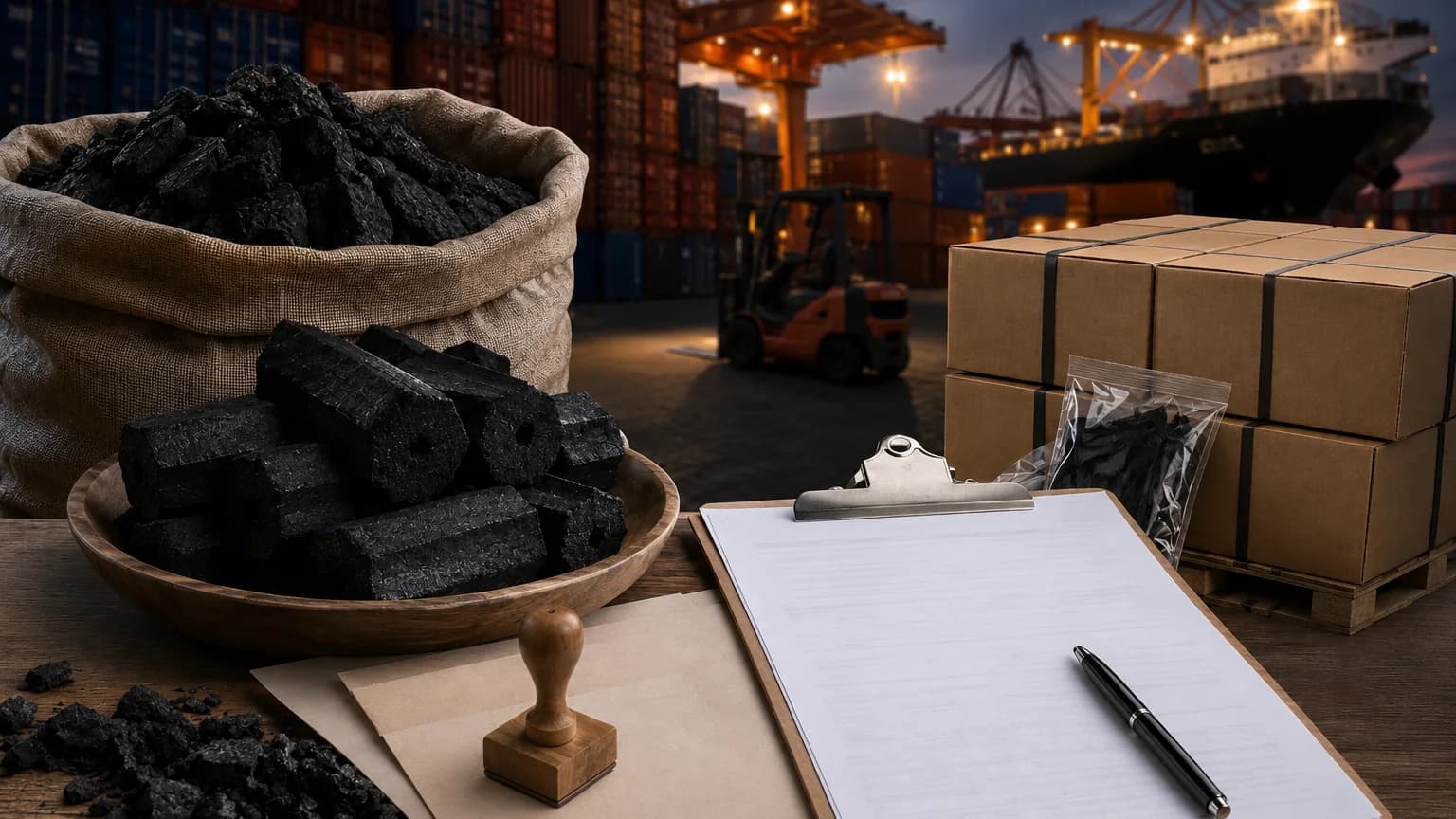
Charcoal Export Documents for Middle East Buyers
Which documents accompany a charcoal shipment to the Gulf, what each one is for, and why your customs broker at the destination is the only authority worth trusting on the details.
by ABRA BRIK Team
The Middle East is the largest destination for shisha-grade coconut charcoal, and the paperwork question comes up in almost every first conversation with a new buyer there.
One caveat before the list, and it is not a formality: requirements differ by destination country and they change. The authority on what your shipment needs is your customs broker at the destination port, not a supplier's article — including this one. What follows is the general shape, so you know what to ask about and when.
The commercial set
These accompany essentially every shipment.
Commercial invoice. The commercial basis of the transaction — parties, goods, value, terms. Customs valuation starts here, so the description should match what is physically in the container.
Packing list. What is in the shipment, how it is packed, weights and counts per package. This is what an inspector compares reality against.
Bill of lading. Issued by the carrier. It is your title to the goods, which is why the original documents matter and why buyers should understand whether they hold an original or a telex release before the vessel arrives.
The origin and content set
Certificate of Origin. States where the goods were produced. It often determines the duty rate applied, so it is worth confirming the correct form with your broker before it is issued — reissuing after arrival is slow.
Certificate of Analysis (COA). The laboratory figures for the material actually shipped: calorific value, ash, moisture, fixed carbon. For shisha buyers this is frequently the document their own customer asks to see, because ash content decides whether the coal is usable in a bowl.
A COA should reference the batch it describes. A report from a different production run is not a COA for your shipment.
MSDS / Safety Data Sheet. Handling and safety information. Many carriers and ports request it for charcoal because of self-heating classification during transport.
What varies, and where to check
Beyond the sets above, requirements diverge sharply:
- Some destinations require fumigation certificates or specific treatment of wooden packaging.
- Some require product registration or labelling in Arabic.
- Halal certification is sometimes requested for products entering food-adjacent supply chains. Whether it applies to charcoal depends on the destination and the buyer's own channel — confirm it, and confirm whether your supplier actually holds it rather than assuming.
- Some buyers require pre-shipment inspection by a third-party agency.
The practical point: several of these must be arranged during production or before loading. Discovering a fumigation requirement after the container is sealed means unsealing it.
The timing that catches people out
A rough sequence for a first shipment:
- Before production — confirm the document list with your broker; agree specification and packaging.
- During production — sampling and laboratory testing for the COA; any required inspection booking.
- Before loading — packaging and count verification, moisture check.
- At loading — documents issued against what actually shipped.
The common failure is treating documents as an after-the-fact administrative task. Half of them describe a physical process that has to have happened.
How we support it
We arrange export documentation support per destination country, and we produce laboratory test results for the batch rather than a generic certificate. Our material is tested at the Ministry of Forestry laboratory in Bogor, accredited by KAN, against SNI 06-3730-1995.
What we will not do is claim a certification we do not hold. If your market requires something we do not currently have, we will tell you that directly — it is a far cheaper conversation than a rejected container.
Shipping to a Gulf market and want to check the list? Tell us the destination country and your buyer's channel, and we will go through what we can support.
Interested in our products?
Chat with us on WhatsApp for pricing, samples, and availability.
Chat via WhatsApp