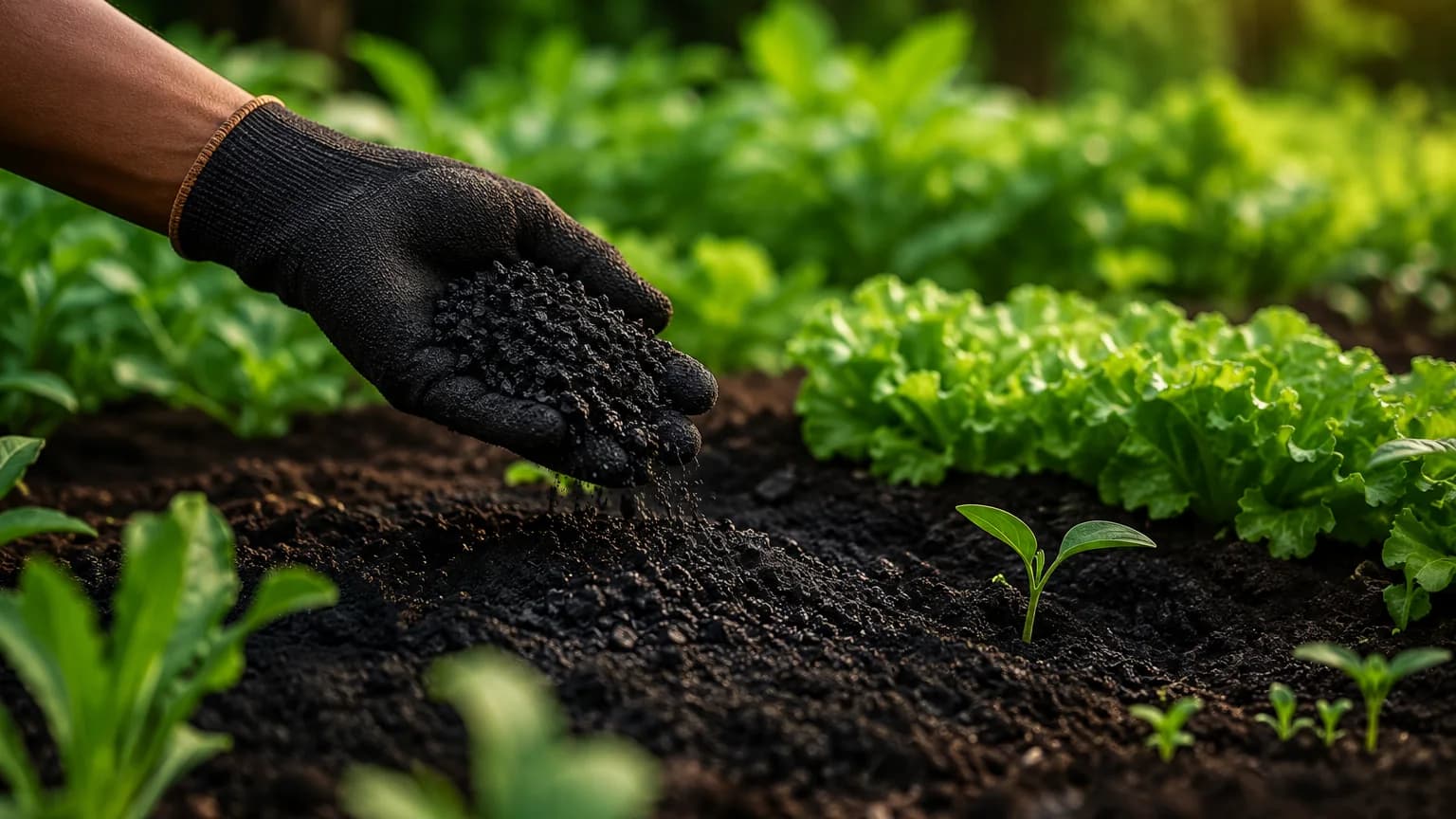
What Biochar Actually Does to Soil
Biochar is not a fertiliser. It changes the physical structure of soil — water retention, nutrient holding, microbial habitat — and that distinction decides whether it works for you.
by ABRA BRIK Team
Biochar is sold as a soil improver, which is accurate but unhelpfully vague. It is worth being precise about the mechanism, because that is what tells you whether it will do anything useful in your particular soil.
Biochar is not a fertiliser. It contains very little plant-available nutrient of its own. What it does is change the physical and biological environment that nutrients move through. On some soils that is transformative. On others it is close to a waste of money — and knowing which is which saves a great deal of it.
The mechanism: surface area
Biochar is charcoal produced specifically for soil use, made by heating biomass with restricted oxygen. The process leaves a rigid carbon skeleton riddled with pores — an enormous internal surface area within a small volume.
Everything biochar does follows from that structure.
Water retention. The pore network holds water against gravity and releases it slowly. In sandy soil, where water drains away before roots can use it, this is the single largest effect and often the reason to apply it at all.
Nutrient holding. Those same surfaces hold nutrient ions that would otherwise leach past the root zone with the next heavy rain. The nutrients still have to come from somewhere — biochar holds them, it does not supply them.
Microbial habitat. The pores shelter soil microorganisms from predation and drying. A more stable microbial population means more consistent nutrient cycling.
pH. Most biochar is alkaline. On acidic soils that is a benefit; on soils already alkaline it is a reason for caution and a soil test before applying at scale.
Where it helps most, and least
Be honest about your starting point:
- Sandy, free-draining soils — the biggest gains, mostly through water retention.
- Degraded or heavily worked soils with depleted organic matter — substantial structural improvement.
- Acidic soils — benefit from the pH shift as well as the structure.
- Already fertile, well-structured loam — measurable effects are often small. The soil already does what biochar would provide.
- Alkaline soils — apply cautiously; you may be pushing pH the wrong way.
The carbon that stays put
Ordinary organic matter decomposes and returns to the atmosphere within a few years. The carbon in biochar is in a form that resists decomposition and can remain in soil for a very long time.
That is why biochar appears in carbon removal discussions rather than only in agronomy ones. For a farm, it means an application is a long-term change to the soil rather than an input that must be repeated every season.
Applying it, briefly
Two practical points that matter more than the rest:
Charge it first. Fresh biochar is empty. Applied raw, those surfaces will adsorb nutrients already in your soil before releasing anything — which can look like a yield dip in the first season. Compost it or soak it in a nutrient solution before applying, so it arrives already loaded.
Incorporate, do not surface-spread. Biochar on the surface blows and washes away. Work it into the root zone.
What we produce
We make biochar from coconut shell and from coffee grounds, at a capacity of up to 90 tonnes a month across charcoal and biochar. Feedstock changes the characteristics, so if you have a specific soil problem, tell us what it is before choosing.
We would rather point you to the right material — or tell you your soil does not need it — than sell you a tonne that does nothing.
Unsure whether your soil would benefit? Tell us the soil type and what you are growing, and we will give you a straight answer.
Interested in our products?
Chat with us on WhatsApp for pricing, samples, and availability.
Chat via WhatsApp