Choosing BBQ Charcoal Briquettes for Restaurants and Grill Houses
A restaurant does not need the hottest charcoal. It needs charcoal that behaves identically every single service — and that is a different purchasing decision.
by ABRA BRIK Team
Home barbecue and commercial grilling are not the same purchase. A home user lights charcoal a dozen times a summer and forgives a bad bag. A restaurant lights it twice a day, every day, and a bad delivery means a chef rebuilding a fire in the middle of service.
That difference should drive what you buy.
Consistency beats peak performance
The single most valuable property of restaurant charcoal is that it behaves the same way it did last week. Your grill team learns a fuel — how long to let it ash over, where the hot zone sits, when to add. Change the burn characteristics and that knowledge is worthless until they relearn it.
This is an argument for briquettes over lump charcoal in a commercial setting. Lump has its advocates and it can burn hotter, but it varies piece to piece and batch to batch. Briquettes are pressed to a controlled density from a controlled feedstock, which is precisely why they are predictable.
When evaluating a supplier, the question is not "how good is this sample" but "how close will the next twenty deliveries be to this sample".
Burn time, and what actually drives it
Density and fixed carbon determine how long a bed holds usable heat. Coconut shell charcoal is naturally dense, which is why it outlasts most wood charcoal at equal volume.
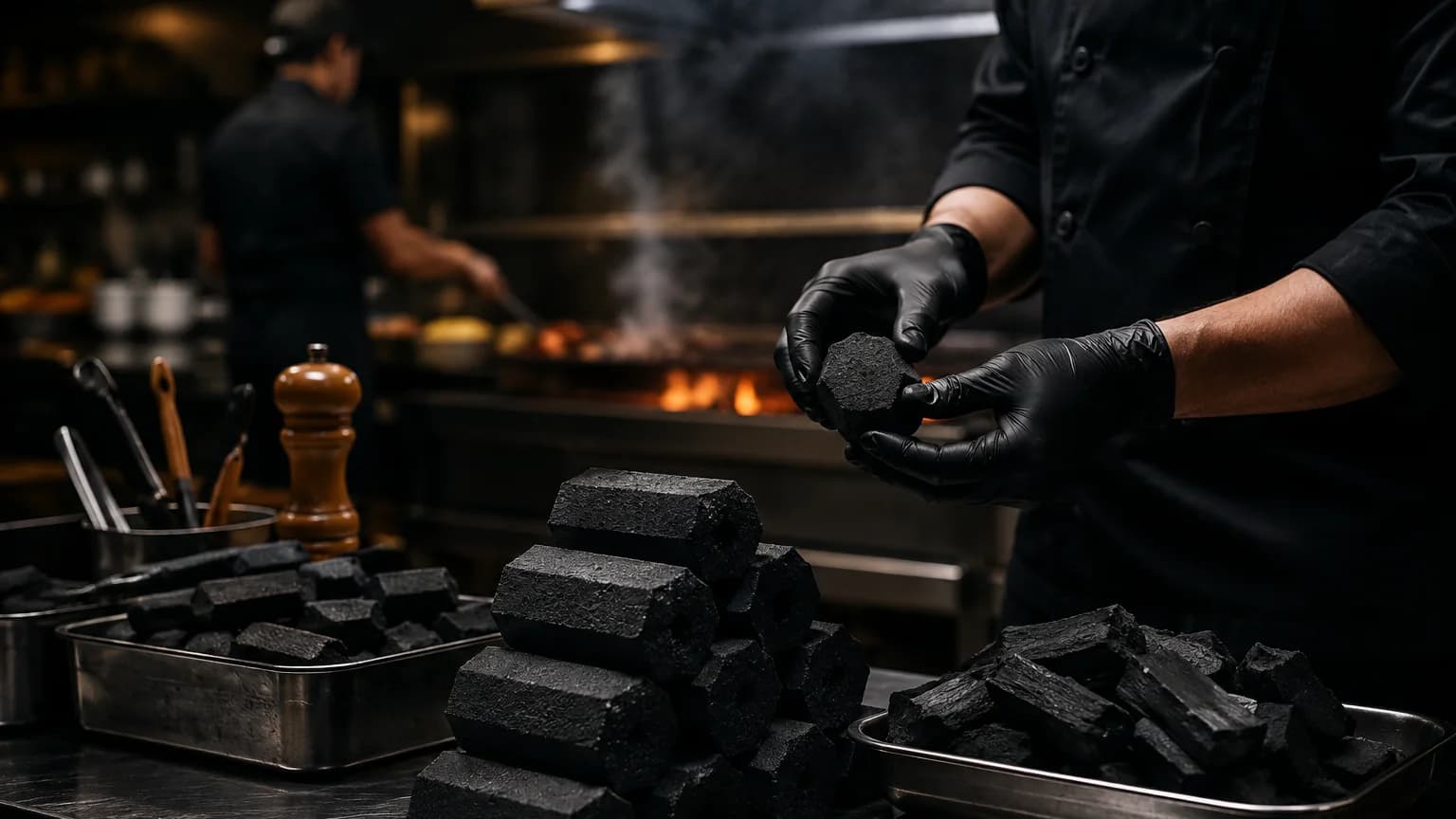
Shape matters as much as material. Hexagonal briquettes with a central hole draw air through the core and hold a steady output far longer than a solid shape of the same weight — the reason they dominate commercial grilling across Asia and the Middle East.
For a grill line running continuous service, that translates directly into fewer interruptions to rebuild the bed.
Ash: how much, and when
BBQ briquettes normally produce 5% to 7% ash, and in a commercial context that is unremarkable — it falls through the grate rather than accumulating in a bowl.
What matters more is when the ash appears. Charcoal that ashes over early smothers its own bed and drops your working temperature midway through a rush. That behaviour comes from feedstock contamination and poor carbonisation, not from the ash percentage on the specification sheet. It is exactly the kind of thing a sample burn reveals and a document does not.
Smoke and smell
Any charcoal that touches food should burn cleanly. Coconut shell charcoal is close to odourless and produces very little smoke once lit, which is why it suits indoor and semi-enclosed kitchens where a smoky fuel would be a ventilation problem.
If a sample smells sharp or chemical when lit, that usually means binder or an incompletely carbonised core. Neither belongs anywhere near a dining room.
Moisture, and why it matters more in the rainy season
Charcoal above roughly 8% moisture is slow to light, spits, and gives inconsistent heat. It also means part of every kilogram you paid for is water.
Ask how the material is dried and how it is packed. Storage matters as much as production — charcoal that left the factory dry and sat on a damp warehouse floor for a month is damp charcoal.
Packaging, sized to how kitchens actually work
This is the most overlooked part of a commercial charcoal contract. A restaurant that burns 40kg a week does not want the same packaging as a distributor moving pallets.
Our standard retail-ready formats are a 1kg inner box, a 5kg pouch and a 10kg corrugated box, and we produce custom formats when a kitchen's workflow calls for something different. If your team decants every delivery into another container, the packaging is wrong.
A practical evaluation
Before signing a supply agreement:
- Burn a sample on your own equipment, during a realistic service load — not in the car park at 3pm.
- Time it. How long from lighting to cooking temperature, and how long does the bed hold?
- Watch the ash. Does it fall away or does it blanket the bed?
- Ask for the laboratory report for the material being offered, with the testing institution named.
- Get the specification into the agreement, along with a delivery schedule matched to your consumption.
Our briquettes are tested at the Ministry of Forestry laboratory in Bogor against SNI 06-3730-1995; report 092/LHU/P2HB/07/2026 records 7,319 cal/g, 3.56% ash and 5.89% moisture for the cube format. We will send you that report with a sample rather than asking you to take our word for it.
Running a grill line and want to test before committing? Tell us your weekly volume and how your kitchen works, and we will arrange a sample.
Interested in our products?
Chat with us on WhatsApp for pricing, samples, and availability.
Chat via WhatsApp